
Stay up to date on news, events and special features.
Family Literacy Day is Monday, January 27th. Check out the display at Education Library!
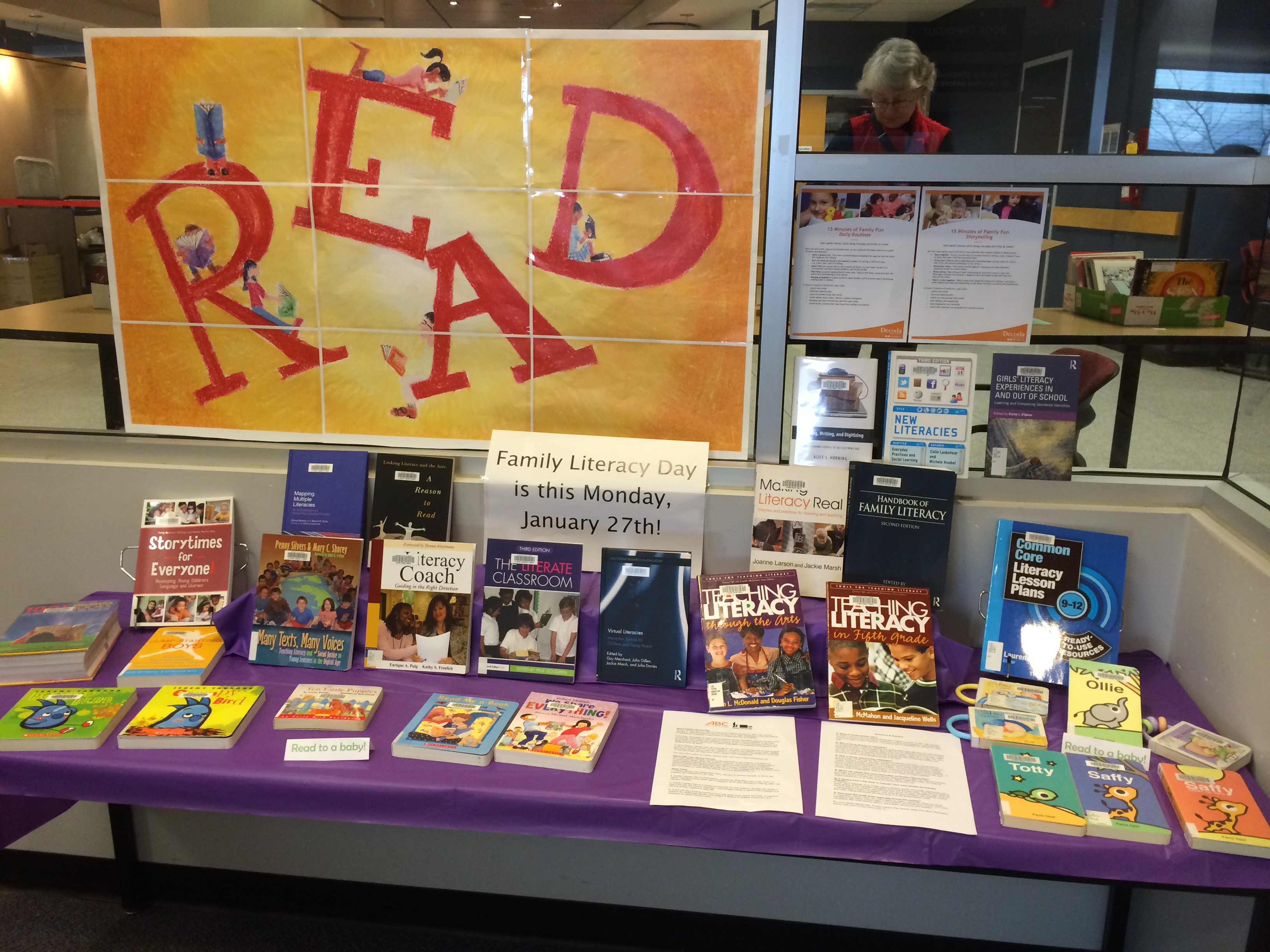 Check out our display for Family Literacy Day!
We have current books on literacy on display as well as a collection of Board Books. Read to a baby!
“Family Literacy Day is a national awareness initiative created by ABC Life Literacy Canada in 1999 and held annually on January 27 to raise awareness of the importance of reading and engaging in other literacy-related activities as a family.
Taking time every day to read or do a learning activity with children is crucial to a child’s development. Even just 15 minutes a day can improve a child’s literacy skills dramatically, and can help a parent improve their skills as well.”
Largest Canadian research on children & teens’ online habits
 (le français suit)
Life online for young Canadians is more connected, more mobile, and more social
http://mediasmarts.ca/ycww/life-online
Download the Life Online infographic!
Ottawa, ON (January 22, 2014) – Canadian children and teens are more connected to the online world than ever through a variety of portable devices, and more connected to others through social networking, according to new research released today by MediaSmarts. Although boys and girls have different experiences online, the Internet is an important source for seeking information, entertainment and socializing for all young Canadians.
MediaSmarts surveyed over 5,000 students in classrooms across the country on their Internet behaviours and attitudes, as part of Phase III of its Young Canadians in a Wired World study. The first report drawn from the survey, Life Online, looks at how youth access the Internet, their main activities and favourite sites, their attitudes towards online safety, household rules on Internet use and unplugging from digital technology.
One of the biggest changes since the survey was last conducted in 2005 is the proliferation of mobile devices, such as tablets, smartphones and MP3 players, which give youth constant – and often unsupervised – online access. The other big change is the growth in social networking, even among children too young to register for these sites: many of the sites that now dominate the list of students’ top 10 favourites – Facebook, Twitter, Instagram, Tumblr and Minecraft – were barely on the horizon, or didn’t exist, in 2005.
“We were surprised at the level of social networking, especially in the younger grades,” said Jane Tallim, Co-Executive Director of MediaSmarts. “With many of these activities taking place on portable devices and fewer family rules about being online, there is a greater need for parents and teachers to educate young people about the issues around socializing and sharing online.”
Key findings include:
· 32% of students in grades 4-6 have a Facebook account and 16% have a Twitter account, even though these sites are restricted to users 13 or older
- Girls are significantly less likely than boys to see the Internet as a safe place
- Students have fewer rules at home about what they can do online since 2005, but there is still a strong connection between having rules and fewer risky behaviours
- Students like to stay connected: more than a third who own cell phones say they sleep with their phones. At the same time more than a third worry that they spend too much time online
- One in six students has gone offline in order to avoid someone who is harassing them
To view the Life Online report, infographic, and slide show, visit http://mediasmarts.ca/ycww.
Follow the conversation using hashtag #YCWW.
Young Canadians in a Wired World – Phase III: Life Online was made possible by financial contributions from Canadian Internet Registration Authority, Office of the Privacy Commissioner of Canada and The Alberta Teachers’ Association.
Future reports based on this data will look at students’ habits, activities and attitudes towards: privacy, digital permanence, bullying, commercialization, offensive content, online relationships and digital literacy in the classroom and in the home.
-30-
MediaSmarts is a Canadian not-for-profit centre for digital and media literacy. Its vision is that young people have the critical thinking skills to engage with media as active and informed digital citizens.
Contact: Maya Shoucair, Communications Officer, MediaSmarts
613-224-7721, ext. 231, mshoucair@mediasmarts.ca
La vie en ligne des jeunes Canadiens est plus branchée, plus mobile et plus sociale que jamais
http://habilomedias/jcmb
Téléchargez l’infographique La vie en ligne!
Ottawa, ON (le 22 janvier, 2014) – Selon une nouvelle étude menée par HabiloMédias, les enfants et les adolescents canadiens sont plus connectés au monde en ligne que jamais grâce à une variété d’appareils portables et sont plus connectés les uns aux autres grâce au réseautage social. Les garçons et filles vivent différentes expériences en ligne, mais Internet demeure une excellente source pour la recherche d’information, le divertissement et la socialisation chez les jeunes Canadiens.
Dans le cadre de son étude Jeunes Canadiens dans un monde branché, HabiloMédias a effectué un sondage auprès de 5 000 élèves dans les salles de classe d’un bout à l’autre du pays à propos de leurs comportements sur Internet et de leurs attitudes à son égard. Le premier rapport tiré du sondage, La vie en ligne, examine la façon dont les jeunes accèdent à Internet, leurs principales activités et leurs sites préférés, leur attitude à l’égard de la sécurité en ligne, les règles à la maison sur l’utilisation d’Internet et leur volonté de se déconnecter.
L’un des changements les plus importants survenus depuis le dernier sondage en 2005, est la prolifération des appareils mobiles, tels que les tablettes, les téléphones intelligents et les lecteurs MP3, qui procurent aux jeunes un accès constant et souvent non supervisé. L’autre grand changement concerne la croissance du réseautage social, même chez les enfants trop jeunes pour s’inscrire à ces sites; un grand nombre des sites dominant maintenant la liste des 10 sites préférés des élèves – Facebook, Twitter, Instagram, Tumblr et Minecraft – ne faisaient que se pointer à l’horizon ou n’existaient pas encore en 2005.
« Nous avons été surpris par la popularité du réseautage social, surtout chez les plus jeunes, a déclaré Jane Tallim, codirectrice exécutive de HabiloMédias. Bon nombre de ces activités prenant place sur des appareils portables et le nombre de règles familiales concernant Internet étant en déclin, il existe une nécessité pressante pour les parents et les enseignants d’éduquer les jeunes à propos de la socialisation et du partage en ligne ».
Les principales conclusions :
· Trente-deux pour cent des élèves de la 4e à la 6e année possèdent un compte Facebook et 16 % ont un compte Twitter, même si ces sites sont limités aux utilisateurs de 13 ans ou plus.
- Les filles sont nettement moins susceptibles que les garçons de voir Internet comme un endroit sécuritaire.
- Les élèves ont moins de règles à la maison qu’en 2005 sur ce qu’ils peuvent faire en ligne, mais il existe toujours un lien étroit entre la présence de règles et l’adoption de comportements à risque.
- Les élèves aiment rester connectés : plus du tiers d’entre ceux possédant leur propre cellulaire affirment qu’ils dorment avec leur appareil. Parallèlement, plus du tiers s’inquiètent de passer trop de temps en ligne.
- Un élève sur six s’est déjà déconnecté afin d’éviter quelqu’un qui le harcelait.
Pour consulter La vie en ligne, des images infographiques et un diaporama, visitez habilomedias.ca/jcmb.
Suivez la conversation en utilisant le mot-clic #JCMB.
Jeunes Canadiens dans un monde branché – Phase III : La vie en ligne a été rendu possible grâce aux contributions financières de l’Autorité canadienne pour les enregistrements Internet, du Commissariat à la protection de la vie privée du Canada et de l’Alberta Teachers’ Association.
Les prochains rapports basés sur ces données se pencheront sur les habitudes, les activités et les attitudes des élèves à l’égard des sujets suivants : la vie privée, la permanence numérique, l’intimidation, la commercialisation, le contenu offensant, les relations en ligne et la littératie numérique en classe et à la maison.-30-
HabiloMédias est un centre canadien à but non lucratif pour la littératie numérique et l’éducation aux médias. Sa vision veut que les jeunes aient les compétences de pensée critique nécessaires pour s’engager auprès des médias en tant que citoyens numériques actifs et informés. habilomedias.ca / @habilomedias
Personne-ressource :
Maya Shoucair, Agente de communication, HabiloMédias
613-224-7721, poste 231, mshoucair@habilomedias.ca @habilomedias
Any Graduate students in Education who need to go through the ethics review process? Sign up for this workshop!
Upcoming Research Commons Graduate Student Workshops and Services

Koerner Library
Photo Credit: Stephen Wu (stephenccwu Flickr)
Changes to the Research Commons One-on-one Consultation Model
The RC is excited to announce a new consultation model for the Winter 2014 Term! We will be holding consistent weekly consultation hours on Tuesdays from 4:00pm – 7:00pm, Wednesdays from 2:30pm-5:30pm, and Fridays from 10:00am-1:00pm in Koerner Library, Room 218A. One-on-one Thesis Formatting, Citation Management and SPSS consultations will all be available at these times.
Key Changes:
- All services (Thesis Formatting, Citation Management, and SPSS) are now available for one-on-one consultations during these times.
- No more setting up an account to book a consultation. Request a consultation online by filling out our web form.
Tips and Tricks for Formatting Your Thesis: Little Things Mean A Lot!
Are you worried about getting your thesis/dissertation into the format required by the Faculty of Graduate Studies? Would you like to know more about how to use the formatting features in Microsoft Word? Research Commons staff will help you with your questions about the nuts and bolts of formatting: tables of contents, page layout, numbering, headings, front matter, and more! As well, find out more about the resources that are available to help you in writing your thesis/dissertation. Graduate students at any stage of the writing process are welcome; some prior knowledge of Microsoft Word will be helpful.
You can register for an upcoming thesis formatting workshop here.
Have specific questions you think would be best answered in a one-on-one session? See our Consultations page to book a session: http://koerner.library.ubc.ca/services/research-commons/
__________________________________________________________________
Citation Management Using RefWorks, Zotero, or Mendeley
Need to manage large numbers of references and citations as part of your research, teaching or administrative work? Citation management tools are for you. These tools provide a simple way to store, organize and retrieve your citations in an effective manner, and can also help you in formatting in-text citations and bibliographies in your work.
Sign up for a tool specific hands-on workshop about the core concepts of citation management and detailed instruction for use of either RefWorks, Zotero, or Mendeley here.
Are you new to citation management tools entirely, or do you have advanced-user questions? See our Consultations page to book a one-on-one session: http://koerner.library.ubc.ca/services/research-commons/.
___________________________________________________________________________________________
SPSS
Workshop 1- Basic SPSS
Do you wonder what SPSS is and how it can be useful to manage and analyze your data? Would you like to learn how to work with SPSS just by clicking a few keys? Let us help you learn the basics.
No previous knowledge of SPSS is required for the first workshop.
Workshop 2- SPSS Data Management
Do you know how to edit your data using effective data management software? Do you want to work with user-friendly software without going through a hassle of writing code? SPSS can do this for you with a few clicks. Attend this workshop and learn how to manage your data fast.
Workshop 3- Descriptive/Graphing Analysis with SPSS
Do you have trouble summarizing your data? Do you want to analyze your data with t-test, ANOVA, Pearson-test, etc. using SPSS? Do you have trouble graphing and presenting your data with SPSS? Well, we can help you with all of these questions. Enroll in this workshop and learn how to analyze your data hassle-free!
You can register for an upcoming SPSS workshop here.
Have specific questions you think would be best answered in a one-on-one session? See our Consultations page to book a session: http://koerner.library.ubc.ca/services/research-commons/.
__________________________________________________________________________________________
Graduate Student Workshop Series
We will be hosting our ongoing series of Graduate Student Workshops in the Research Commons. The topics for January include conducting literature reviews, building your academic profile through the use of social media, digging into digital book collection, and author rights. We are also excited to have the Office of Research Services come in to present on research ethics and the RISe application process for behavioural science research projects at UBC. You can explore upcoming workshops and register online at http://elred.library.ubc.ca/libs/series/7
__________________________________________________________________________________________
FIREtalk: Creativity and Innovation, Wednesday January 29th 4-6 pm.
Where do creative and novel ideas come from? Can tools or techniques stimulate creativity and innovation? Are creative processes the same across disciplines? Submit to present and share your approach towards creativity and innovation.
To sign up as an attendee click on the following link:
http://elred.library.ubc.ca/libs/dashboard/view/4617/
If you have any questions, please do not hesitate to contact us by email at research.commons@ubc.ca
Serendipity 2014: Children’s Literature in a Digital Age
Saturday, March 8, 2014
UBC Education Building | 8am-4pm (lunch is included)
 From practical advice on using literature-based apps with children to learning how authors and illustrators are using social media and electronic publishing, Serendipity 2014 is a must-attend event for educators, librarians, researchers and literature lovers looking to the future of books for young people.
We have invited presenters who are not only at the forefront of the rapidly-evolving world of technology and children’s books, but are also dynamic, engaging, and will leave you inspired and full of ideas:
- Paul Zelinsky (@paulozelinsky): Caldecott-winning illustrator of over two dozen books
- Arthur Slade (@arthurslade): Governor-general’s award-winning author
- John Schumacher (@MrSchuReads): Library Journal Mover and Shaker, elementary school teacher-librarian, blogger, 2014 Newbery Committee member
- Travis Jonker (@100scopenotes): School Library Journal blogger, elementary school teacher-librarian, 2014 Caldecott Committee member
- Tim Federle (@TimFederle): Author of Better Nate Than Ever and the forthcoming sequel Five, Six, Seven, Nate! (January 2014)
- Hadley Dyer (@hedyer): WInner of the Information Book Award for Potatoes on Rooftops: Farming in the City
REGISTER @ http://vclr.ca/registration/
EARLY BIRD REGISTRATION until January 31, 2014: Members $150, Non-Members $165, Students $75
REGULAR REGISTRATION starts February 1, 2014: Members $200, Non-Members $215, Students $100)